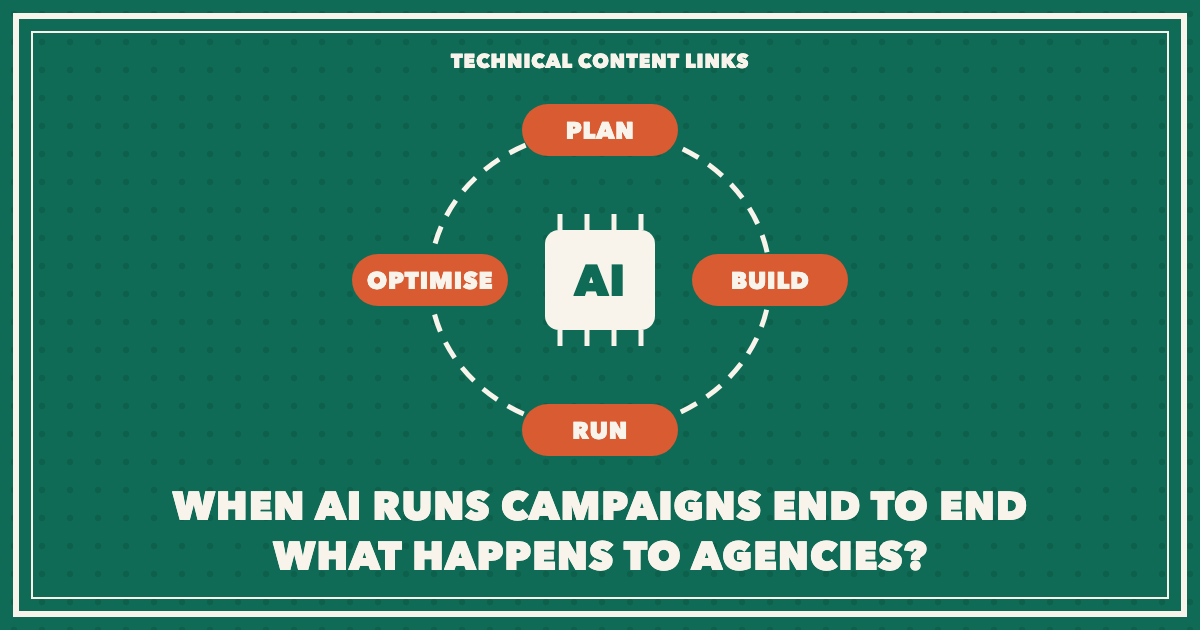
“AI is going to run entire campaigns without humans” has been a prediction for long enough that it’s worth asking a more precise question: how close is that actually to true right now, at the end of 2026, and what does the honest answer mean for how agencies should be planning?
The data gives a clearer picture than the hype cycle suggests — and it’s more interesting than either the “AI will replace agencies” or “AI is overhyped, nothing’s really changing” camps want it to be.
The gap between what CMOs claim and what they’ve built
BCG’s 2026 survey of 300 global CMOs surfaces this gap directly, and it’s larger than most industry commentary acknowledges. 96% of CMOs say AI is driving end-to-end transformation of their marketing function. But when BCG asked what that actually looks like in practice, the picture changes sharply: 42% said they use generative AI only to assist humans with discrete, individual tasks. Just under a third have moved to genuinely agent-led workflows. And only 8% run campaigns where multiple AI agents operate autonomously together.
That’s not a small gap between claim and reality — it’s close to a 90-point one on the headline number versus the number that actually describes full autonomy. McKinsey’s independent research lands in a similar place: 62% of organizations are experimenting with agentic AI, 23% are scaling it somewhere in the enterprise, but no more than 10% are scaling agents in any single business function as of the most recent data.
Where the real adoption is actually happening
Adoption is real, it’s just uneven rather than universal. Salesforce’s tenth State of Marketing report, which surveyed 4,450 marketing decision-makers, found that 75% of marketers have now adopted AI — yet 84% admit they’re still running generic campaigns. The dividing line is data: marketers with unified data are 60% more likely to use AI agents to help scale their efforts. That’s genuinely fast movement on adoption, but it’s concentrated among teams whose data foundations are ready for it.
The use cases where autonomy is furthest along are also specific, not general: paid media bid management (adjusting bids in near real-time against ROAS targets), lead scoring and routing, and campaign reporting and analysis. These share a common trait — high-frequency, well-defined decisions with clear, measurable feedback loops. That’s a very different thing from “an AI agent plans and runs an entire integrated campaign strategy,” which remains rare.
What full autonomy actually looks like when it works
The clearest real-world proof point comes from advertising agency Butler/Till, which ran what’s been documented as the first fully autonomous end-to-end campaign for Geloso Beverage Group’s Clubtails brand in the first half of 2026. The results, independently audited by verification firm Jounce: 82% lower buy-side supply chain costs (a 5.5x reduction), 40% more impressions delivered than planned, 30% lower CPMs, and a 98% video completion rate, with made-for-advertising inventory measured under 1% — meaningfully cleaner than typical industry benchmarks.
That’s a genuinely impressive result, and it’s real evidence the underlying capability works. It’s also, per IAB research, still an early-adopter case: among US digital video buyers, 21% report agentic ad campaigns already live, 20% testing, and 25% planning — meaning the majority of the industry hasn’t started yet, even as the technology itself has clearly cleared the “does this actually work” bar.
Why “not yet at scale” isn’t the same as “won’t happen”
The caution flags in the data are real and worth taking seriously rather than dismissing as incumbent-agency defensiveness. Gartner projects that over 40% of agentic AI projects will be canceled by the end of 2027, citing escalating costs and unclear business value. Deloitte’s research found only 1 in 5 organizations has a mature governance model for autonomous AI agents — meaning the majority of companies deploying them are doing so without the oversight infrastructure to manage what happens when an autonomous system makes a costly mistake at speed. And separately, 45% of martech leaders report that vendor-supplied AI agents have failed to meet the business performance they were promised.
None of that means the trajectory reverses. It means the current phase looks less like “autonomous agents versus human marketers” and more like what industry researchers are increasingly calling governed autonomy: spend caps, approval gates, and audit trails that let an organization trust an agent with real budget without removing human accountability entirely. The agencies and platforms building that governance layer now — not the ones chasing full autonomy fastest — are the ones positioned well for whichever pace the next two years actually move at.
| Adoption reality, 2026 | Figure |
|---|---|
| Marketers who have adopted AI (any use) | 75% |
| CMOs running fully autonomous multi-agent campaigns | 8% |
| Organizations with mature agent governance | ~21% |
| Agentic AI projects projected to be canceled by 2027 | 40%+ |
Sources: Salesforce State of Marketing (10th edition, 2026); BCG 2026 CMO survey; Deloitte 2026; Gartner 2025
What this means for how agencies should actually plan
The honest read of the data: full end-to-end autonomous campaign management is real, technically proven, and already delivering genuinely strong results for the organizations executing it well — but it remains a minority practice concentrated in enterprise, in specific high-frequency use cases, and increasingly wrapped in governance infrastructure rather than left fully unsupervised. The agencies most exposed aren’t the ones who ignore this shift entirely, nor the ones who overcorrect and try to sell “fully autonomous AI campaigns” before the governance and reliability data supports doing so responsibly. It’s the ones who don’t build any agentic capability at all while the adoption curve — 75% of marketers already using AI — keeps compounding underneath them.
Further reading: BCG’s full 2026 CMO survey on agentic marketing transformation and Adgentek’s documented Butler/Till autonomous campaign case study.