Every agency has had some version of this conversation in the last year. A client forwards an article about answer engine optimisation, or generative engine optimisation, or whatever the acronym is this month, and asks a simple question: “Are we doing this?”
There are two easy answers, and both are wrong. The first is to treat AEO as a brand new discipline, spin up a separate line item and sell it as something the client has been missing. The second is to dismiss it as SEO with a new label and change nothing. The more accurate answer is less convenient: AEO is built on the same foundations as SEO, but it is far less forgiving of the shortcuts SEO has tolerated for years.
AEO vs SEO: what each one is actually trying to do
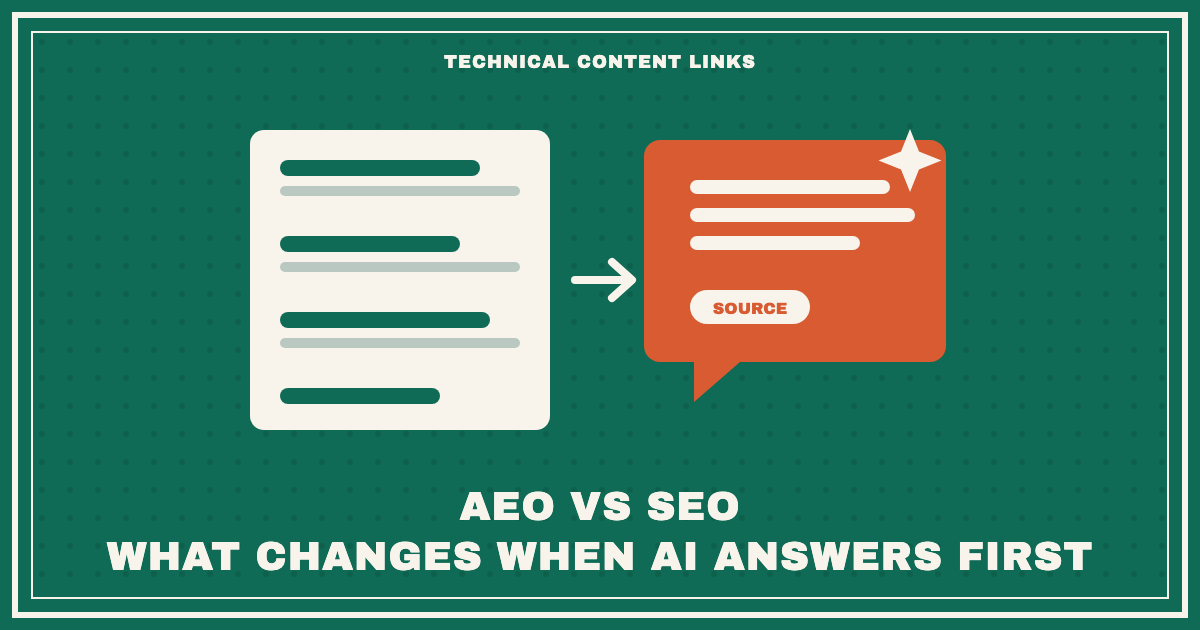
SEO is the work of earning a place in a ranked list of results. Success is a position, and a position becomes a click when the listing is compelling enough.
AEO is the work of becoming a source an AI system draws on, and ideally cites, when it answers a question directly. That covers Google’s AI Overviews and AI Mode as well as ChatGPT, Perplexity, Gemini and Copilot. Success is being part of the answer, whether or not anyone clicks. Generative engine optimisation (GEO) describes the same goal. The term comes from a 2023 research paper from Princeton and collaborators, which found that specific content changes could lift a source’s visibility in generative answers by up to 40%.
The distinction matters because the unit of success has changed. SEO rewards the page. AEO rewards the passage: the specific, extractable piece of a page that answers the question better than anyone else’s.
Where AEO and SEO overlap more than the hype admits
For Google’s own AI surfaces, the overlap with traditional rankings is large. Ahrefs’ research found that 76% of AI Overview citations come from pages already ranking in Google’s top 10. If a client’s site can’t be crawled properly, has weak authority or doesn’t rank for anything meaningful, no amount of “AEO” will fix that. The technical and authority work agencies already do is still the price of entry.
This is the part the new-discipline crowd tends to skip. An agency that sells AEO to a client whose fundamentals are broken is selling a roof for a house with no foundation.
Where they diverge, and why it matters
Outside Google, the picture changes sharply. The same Ahrefs study looked at 15,000 queries run through ChatGPT, Gemini, Copilot and Perplexity. Only about 12% of the URLs those assistants cited ranked in Google’s top 10 for the same query, and roughly 80% didn’t rank for it at all. Perplexity was the closest to Google at 28.6%. The others averaged around 8%.
That is not evidence that rankings don’t matter. It is evidence that assistants don’t simply copy the search results. They break a question into smaller questions, look for the passages that answer each one most directly, and assemble a response. A page can rank well for a broad term and still never be cited, because nothing on it answers the specific question cleanly. Another page that ranks for nothing can be cited because it does.
| SEO | AEO | |
|---|---|---|
| Goal | Rank in a list of results | Be used and cited in an AI-generated answer |
| Unit that wins | The page | The passage that answers a specific question |
| What gets rewarded | Relevance, authority, a compelling listing | Relevance and authority, plus clarity, directness and corroboration from other sources |
| Main measures | Rankings, clicks, conversions | Citations, share of voice in AI answers, assisted enquiries |
| Main risk | Losing position to a competitor | Being summarised without being named |
The excuses AEO removes
This is the real shift. Traditional SEO has always had room for content that ranked without being especially good. AI answers close a lot of that room.
- “It ranks, so the content is fine.” Ranking and being the clearest answer were never the same thing, but a ranking used to be enough to earn the click. When the AI writes the answer, the page that explains it best is the one that gets used.
- “The answer is in there somewhere.” Long introductions that hold back the point, padded word counts and answers buried in paragraph nine are hard for a model to extract and quote. Answer first, then expand.
- “Links will carry it.” Authority still matters, as the AI Overview data shows. But links can’t make a vague page specific. Authority gets a page considered; clarity gets it used.
- “Brand mentions are a nice-to-have.” AI systems appear to draw on how consistently a brand is described across the web: reviews, directories, industry coverage and third-party articles. A client that only talks about itself on its own site gives an AI very little to corroborate.
- “The report shows rankings went up.” If AI answers absorb a growing share of the questions a client cares about, a rankings report can look healthy while the client’s real visibility shrinks. We made a broader version of this argument in why most marketing reporting is theater.
What this means for how agencies position AEO
The agencies handling this well tend to do three things.
They don’t sell AEO as a silo. It isn’t a separate team or a separate strategy. It changes how the existing work is done: how briefs are written, how pages are structured, how schema is used, where authority is built and what gets measured. Selling it as a disconnected add-on usually means duplicated effort and a client who can’t see how the pieces fit.
They are honest about measurement. AI answers vary by prompt, by user and by day. Tracking a defined set of prompts across platforms and reporting citation share over time is useful. Promising a client a fixed “AI ranking” is not, because no such thing exists.
They connect it to the money. Not every query is worth optimising for AI answers. Informational queries are where AI Overviews have hit click-through rates hardest. Commercial and local queries behave differently, and that changes where budget should go. We covered the economics in what AI Overviews mean for your paid vs organic budget.
The bottom line
AEO vs SEO is a false choice. The foundations are shared, and on Google they are most of the job. What AEO adds is a higher standard. It favours the source that answers most clearly, is corroborated by others and is structured so a machine can use it. Agencies that already hold their SEO work to that standard will find AEO an extension of what they do. Agencies that have relied on rankings to cover for average content will find the gap harder to hide.
FAQ
Is AEO replacing SEO?
No. Google’s AI Overviews mostly cite pages that already rank well, so SEO remains the foundation. AEO extends it by optimising for the specific passages AI systems extract, and for visibility in assistants that don’t simply mirror search rankings.
Is GEO different from AEO?
In practice they describe the same goal: being used and cited in AI-generated answers. GEO (generative engine optimisation) comes from academic research. AEO (answer engine optimisation) is the more common industry term.
How do you measure AEO?
Track a fixed set of prompts that matter to the business across the major AI platforms. Then report how often the brand is cited or mentioned, against competitors and over time. Pair that with assisted conversions and branded search trends, rather than relying on any single “AI ranking”.
Should agencies charge separately for AEO?
That depends on scope. Ongoing citation tracking and answer-focused content work are real additional effort. But positioning AEO as completely separate from SEO usually confuses clients and duplicates work.
If your clients are asking about AI visibility, see how our white label AEO service fits alongside the SEO work you already deliver.