“SEO reseller” and “white label SEO” get used interchangeably in most agency conversations, and in practice the line has blurred. But the distinction matters more than it might seem, because it determines how much control you keep over strategy, reporting, and the client relationship — and which model actually solves the problem your agency has.
Industry-wide, the pressure to choose one or the other is only growing. Market researchers put the outsourced SEO services market at close to $84 billion globally in 2026, and a growing share of that spend is agencies buying SEO capacity from other agencies rather than hiring it in-house.
What is an SEO reseller?
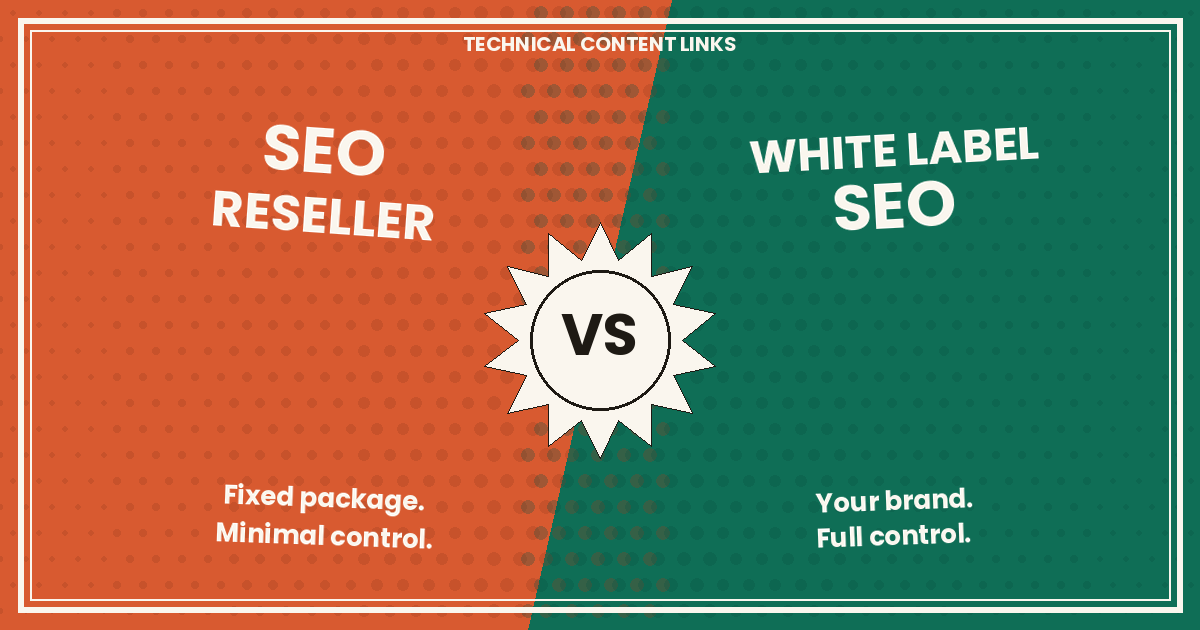
An SEO reseller buys SEO services at a wholesale rate and resells them to clients, typically with minimal involvement in strategy or execution. The reselling agency marks up the price and passes the work through largely untouched — fixed packages, limited customisation, and often little visibility into how the work is actually delivered. It’s a fast way to add “SEO” to a service list, but it’s a thin layer over someone else’s process.
What is white label SEO?
White label SEO is a deeper partnership. The provider still does the execution, but reporting, communication, and often strategy input are built around your agency’s brand and your client’s specific goals. Your clients deal with you, see your branding on every report, and never know a third party is involved. Rather than a pass-through supplier, the provider functions as an extension of your team.
This model has been gaining ground specifically because agencies are hitting capacity limits: survey data shows white label partnerships are viewed as a genuine growth lever by roughly a third of smaller agencies, not just a stopgap.
SEO reseller vs white label SEO, side by side
| Factor | SEO reseller | White label SEO |
|---|---|---|
| Branding | Often minimal or none | Fully branded as your agency, end to end |
| Customisation | Fixed packages | Built around each client’s niche and goals |
| Client relationship | Underlying provider sometimes visible | Stays entirely with your agency |
| Account support | Delivered package, limited input | Dedicated account manager, direct strategy input |
| Typical gross margin | Roughly 20–35%, capped by wholesale rate | Roughly 40–65%, scales with your own positioning |
| Best for | Agencies wanting the lowest-effort entry point | Agencies that need real capacity without diluting their brand |
Why this distinction matters more than it looks like it should
Link building is where the difference shows up fastest. Across industry surveys, more than half of digital marketers name link building as the hardest part of SEO to execute well, and a 2026 survey of 518 SEO professionals by Editorial.link found agencies allocate roughly a third of their entire SEO budget to it — with more than half outsourcing at least part of that work rather than trying to staff it fully in-house.
That pattern splits cleanly along the same growing-vs-struggling line: agencies still building out their SEO offering often lack the relationships and processes to do link building well from day one, while agencies with an established department frequently find link building is the specific function that stops scaling — quality control gets harder to maintain as volume increases, and it’s usually the first thing to slip when the team is stretched.
What agencies actually pay — and what they keep
The margin gap between the two models is bigger than most agencies expect going in, and it’s the clearest financial argument for choosing one over the other.
Reseller programs are structurally capped: you’re marking up someone else’s fixed package, so your ceiling is whatever markup the provider tolerates before you’re no longer competitive. Benchmarks across multiple 2026 pricing surveys put reseller-model gross margins around 18–35%, depending on the provider and package tier.
White label arrangements work differently, because you’re pricing your own strategy, account management, and client relationship on top of fulfilment — not just reselling a box. Wholesale white label SEO typically runs $350–$8,000 a month depending on scope, resold at a 2–3x markup, which lands most agencies in a 45–65% gross margin band — with digital PR and link building specifically reselling toward the richer end of that range, since editorial placement is the hardest deliverable to fake at volume.
Put in dollar terms: a $1,500/month wholesale package resold at $3,000–$4,000/month retail nets roughly $1,500–$2,500 a month in gross margin per client under a white label structure — well above what the same account would return under a reseller markup.
Which model fits your agency?
If you’re growing an SEO offering from scratch, a straightforward reseller arrangement can feel like the lower-risk starting point. But it also means less control over quality and no real strategic input, which makes it hard to build client trust once you’re competing on results rather than price.
If you already have an SEO department that’s stretched — most commonly on link building — white label SEO is the better fit. You keep your existing client relationships and reporting standards, and use a partner to fill the specific gap without diluting your brand.
Vetting a partner: the red flags that matter
Whichever model you choose, the wrong partner does more damage under your brand than a competitor ever could. A few warning signs worth checking before you sign anything:
- Full retainers priced under roughly $300/month. White-hat editorial link building isn’t economically possible at that price point — something is being cut, usually link quality or content review.
- No sample reports or case studies they’re willing to show. Legitimate providers are proud of their delivery and will walk you through real (anonymised) results.
- Vague answers about link sourcing. If a provider won’t explain where links actually come from, assume the worst — PBNs, link farms, or marketplace placements that carry real de-indexing risk for your client’s site.
- No named senior staff behind the strategy. A rotating cast of anonymous freelancers is a reseller red flag specifically, since it usually means no one is accountable for campaign direction.
- Reluctance to put SLAs or a non-compete in writing. A genuine white label partner should be comfortable formalising that they won’t contact your clients directly.
How agencies typically move from reseller to white label
Most agencies don’t pick a model once and stay there. It’s common to start with a reseller arrangement to validate that clients actually want SEO, then transition to white label once volume justifies the deeper setup. The switch usually looks like this:
- Audit current accounts — which clients are on fixed reseller packages that don’t fit their actual needs anymore?
- Brief a white label partner on live accounts so delivery doesn’t lapse during the handover.
- Move reporting and communication onto your own branded templates, since white label deliverables are built around your brand from the outset rather than lightly rebranded.
- Reprice existing accounts gradually as contracts renew, rather than all at once, to protect retention through the transition.
The transition is agency-side only — clients experience no change in how the engagement runs, which is exactly the point of the model.
How Technical Content Links works with agencies
We run a white label model, not a resale model. Every deliverable is built around your client’s actual goals, every report carries your branding, and you get a dedicated account manager rather than a fixed package.
Technical Content Links has been delivering white label SEO for agencies since 2020. We’re led by a former COO of Online Marketing Gurus, one of Australia’s largest digital marketing agencies, and we deliver fulfilment in partnership with Four Dots — an independent white label SEO company with over a decade of experience building link profiles for agency partners across Australia, the US, and the UK. That partnership gives agencies real delivery capacity whether you’re building an SEO offering for the first time or your current team needs help keeping up, particularly on link building.
We also work with agencies on the wider offering — white label PPC and white label copywriting — for agencies that want a single fulfilment partner rather than several.
FAQ
Is white label SEO more expensive than reseller SEO?
Usually somewhat, because you’re paying for customisation, account management, and direct strategy input rather than a fixed package. Most agencies find the difference is offset by better retention and a substantially wider margin band, since results and reporting are tailored rather than generic.
Will my clients know a third party is involved?
No — that’s the core of the model. Every report, call, and deliverable carries your agency’s branding.
Can I switch from a reseller model to white label later?
Yes, and many agencies do exactly this once they’ve validated demand and want more control over quality and client experience. See the transition steps above.
What margin should I expect from either model?
Reseller programs typically land agencies in the 18–35% gross margin range, capped by the provider’s wholesale rate. White label arrangements typically run 45–65%, since you’re pricing your own strategy and account management on top of fulfilment rather than just marking up a fixed package.
How do I vet a white label or reseller partner before signing?
Ask for sample reports, ask specifically how links are sourced, confirm there’s named senior staff behind strategy (not just rotating freelancers), and get a non-compete in writing. Treat any full SEO retainer priced under roughly $300/month as a reason to ask what’s being cut.